 Borokhim's Oriental Rugs on
Bijar vs. Heriz vs. Tabriz: Which Persian Rug Is Right for Your Home?
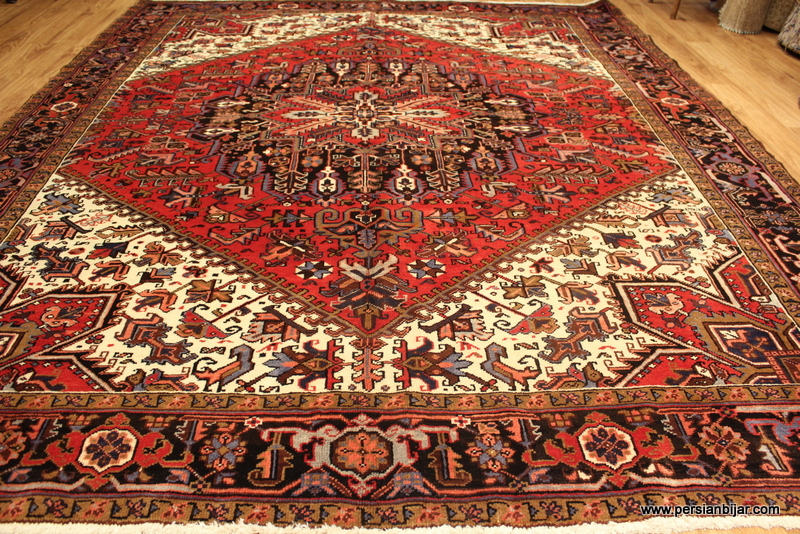
Style: Heriz
By Borokhim’s Oriental Rugs · Madison, Wisconsin
Bijar, Heriz and Tabriz are three of the best-known Persian rugs sold in the United States. All three come from north-western Iran, all are hand-knotted in wool, and all can last for generations. They look and feel very different, though, and each suits a different kind of room.
This comparison is written for people choosing between them. It covers how each rug looks, how it is woven, how it wears, and where it works best in an American home.
| Choose a Bijar | for the hardest-wearing rug of the three, with dense, small-scale patterns that suit dining rooms, hallways and busy family rooms. |
| Choose a Heriz | for a bold, geometric statement in a living room or great room. It is relaxed, tough and works with both traditional and modern furniture. |
| Choose a Tabriz | for fine detail and a more formal look. It is the most refined of the three and the widest in range of designs. |
 Bijar
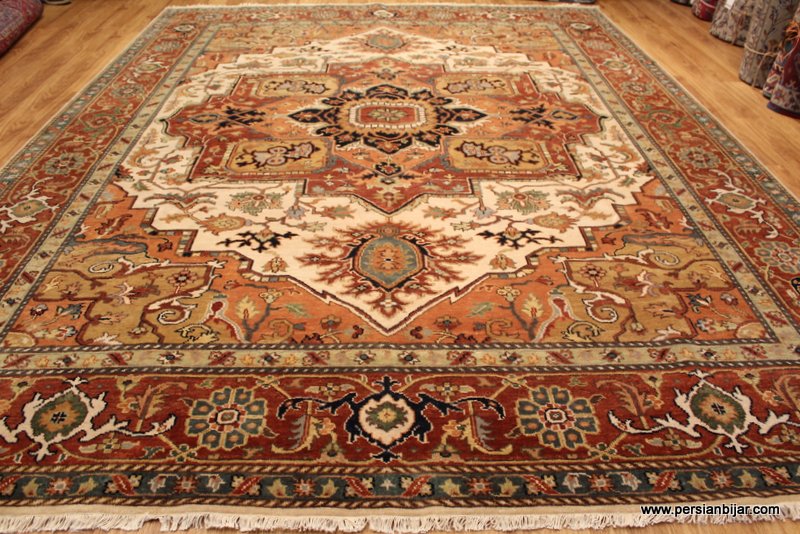 Heriz
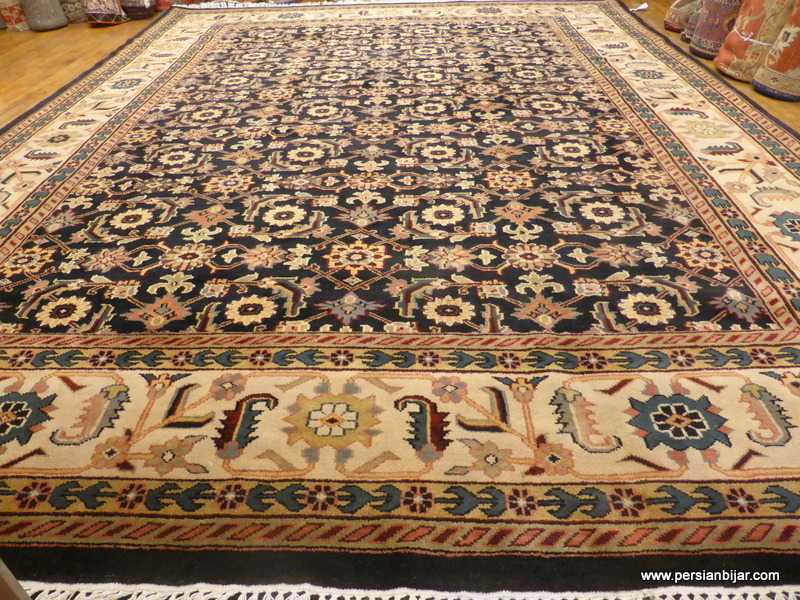 Tabriz
Bijar, Heriz and Tabriz side by side
| Bijar | Heriz | Tabriz | |
|---|---|---|---|
| Woven in | Bijar and nearby villages, Kurdistan province | Heris and nearby villages, East Azerbaijan province | The city of Tabriz, East Azerbaijan province |
| Look | Dense, small repeating motifs, often around a medallion | Large angular medallion with big corner pieces | Curving, finely drawn florals and medallions |
| Typical patterns | Herati, Mina Khani, Garrus | Geometric medallion and corners | Medallion, Mahi, garden, hunting and pictorial designs |
| Weave | Very tightly packed; wefts beaten down while damp | Thicker yarn and a lower knot count, on a sturdy foundation | Fine yarn and a high knot count; some have silk highlights |
| Feel | Heavy, firm and stiff | Thick and substantial | Thinner, more supple, crisp in detail |
| Durability | Exceptional | Very high | Good to very good, depending on fineness |
| Best rooms | Dining rooms, halls, stairs, family rooms | Living rooms, great rooms, dens | Formal living and dining rooms, bedrooms, studies |
| Decor it suits | Traditional, tailored, library-style | Casual, rustic, transitional, modern | Formal and classic |
Bijar: the Iron Rug of Persia
Bijar rugs are woven by Kurdish families in and around the town of Bijar. Their reputation rests on one thing: density. The weavers dampen the wefts and hammer every row of knots down with a heavy comb, so the finished rug is heavier and stiffer than any other Persian type.
The patterns are usually small in scale. The best known is the Herati, a repeating diamond-and-leaf motif, either covering the whole field or set around a central medallion. Colors are deep reds, navy and ivory.
A Bijar is the rug to choose when wear is the main concern. It is also a quiet rug visually. The small pattern hides crumbs and footprints and does not compete with busy furniture or wallpaper. Our guide to what a Bijar rug is explains the weaving method in detail.
Heriz: bold and geometric
Heriz rugs come from the town of Heris and the villages around it, in the mountains east of Tabriz. You can recognize one from across a room: a large, angular medallion in the center, strong outlines, and big stepped corner pieces, usually in brick red, navy and ivory with touches of light blue and green.
The wool is thick and the knot count is lower than in a Bijar or Tabriz, which gives the drawing its bold, almost architectural character. The construction is very sturdy. Heriz rugs have been popular in American homes for well over a century, and older, finer examples are often sold under the name Serapi.
Most Heriz rugs are room-size. They are a natural choice for a living room or a great room where the rug is meant to be the centerpiece, and they sit as comfortably with a leather sofa and modern lighting as with antiques.
Tabriz: fine and formal
Tabriz is one of the oldest and largest weaving cities in Iran, and its workshops produce a wider range of designs than almost anywhere else: central medallions on floral fields, all-over Mahi patterns, garden and hunting scenes, even woven pictures.
Tabriz rugs are graded by a measure called raj, the number of knots across a span of about two and three-quarter inches. The higher the raj, the finer the rug and the sharper the drawing. Fine pieces often have silk outlining the flowers, which catches the light.
A Tabriz is thinner and more supple than a Bijar or Heriz. It wears well, but the very finest pieces are better kept for rooms with lighter traffic, such as a formal living room, a master bedroom or a study.
How to choose between them
Many homes end up with more than one. A Heriz in the living room, a Bijar under the dining table and a Bijar runner in the hall is a classic combination, and because all three share the same reds, blues and ivories, they sit together easily.
Common questions
Which is the most durable: Bijar, Heriz or Tabriz?
Bijar. Its wet-packed weave makes it the toughest hand-knotted rug in regular production. Heriz is close behind.
Which has the finest weave?
Tabriz, in general. Workshop Tabriz rugs reach higher knot counts than most Bijar or Heriz rugs, although the best Bijars, often called Halvai, are also very fine.
Can I use different Persian rugs in the same house?
Yes. It is the traditional way to furnish with them. Keep one or two colors in common from room to room and vary the pattern scale.
Which is best under a dining table?
A Bijar. The pile is dense enough that chairs slide easily and do not leave lasting marks.
Compare them for yourself
Borokhim’s has specialized in hand-knotted Persian rugs since 1972. Browse each collection online, or ask us to help you choose for a specific room.
