 Borokhim's Oriental Rugs on
Soumak Rugs: The Flat Weave That Looks Embroidered
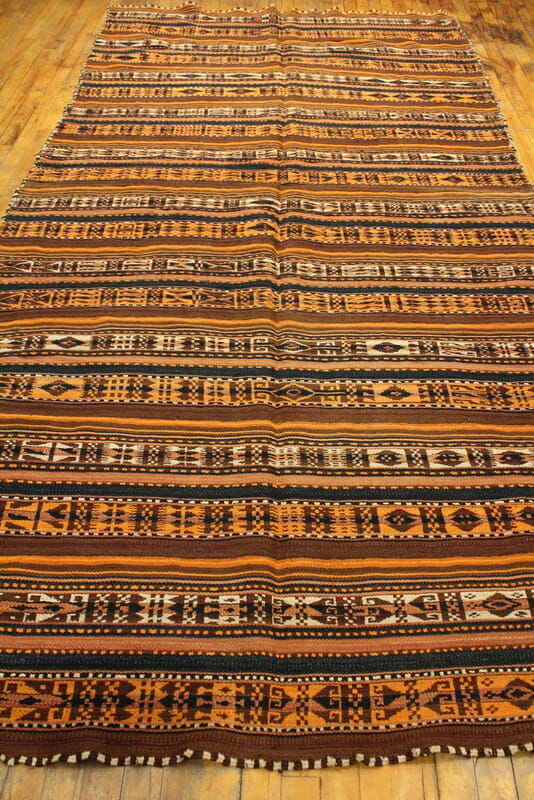
Style: sumac
By Borokhim’s Oriental Rugs · Madison, Wisconsin
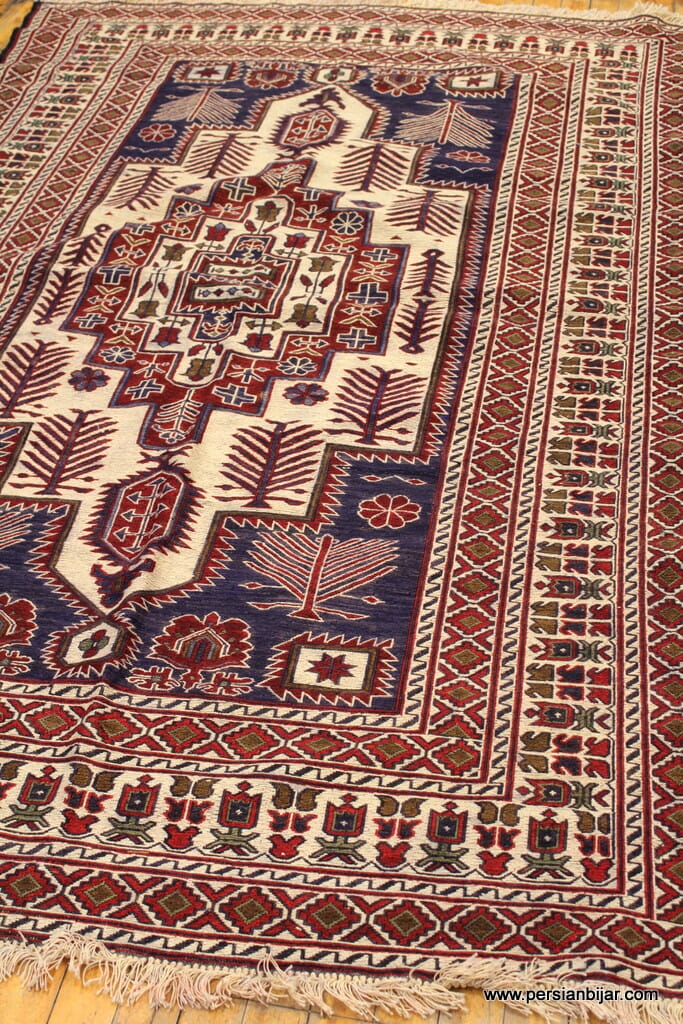
At first glance a Soumak looks embroidered. Its surface is covered in fine slanting stitches that build up into medallions, stars and stylized animals, with a texture you can feel under your hand. It is a flat-woven rug, like a Kilim, but it is made by a different technique, and it is thicker, stronger and more richly detailed.
This guide explains how a Soumak is woven, how to tell it from a Kilim, and where it works best in a home.
| What it is | A flat-woven rug made by wrapping colored yarn around the foundation threads |
| Also spelled | Sumak, Sumac, Soumac |
| Woven in | The Caucasus, Persia and neighboring regions |
| Materials | Mostly wool |
| Look | Geometric medallions, stars and tribal symbols, with a ribbed, stitched surface |
| Colors | Crimson, indigo, ivory and earthy tones |
| Reversible | No. The back is covered in loose yarn ends. |
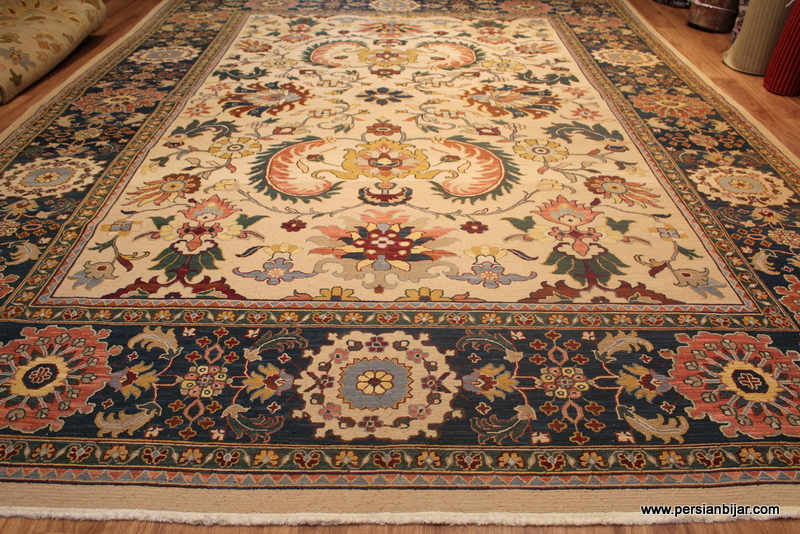
How a Soumak is woven
In a Kilim the colored yarn passes simply over and under the foundation threads. In a Soumak the weaver wraps it. She carries the yarn forward over several foundation threads, then back under a couple of them, and forward again, row after row.
Each wrap sits at a slant. When one row slants to the left and the next to the right, the surface takes on a fine herringbone texture. This is what makes a Soumak look stitched or braided.
When the weaver changes color she leaves the cut ends of yarn hanging on the back. On an old Soumak the back is a shaggy mass of these ends. They are not a fault. They act as a built-in cushion, and they are one of the quickest ways to recognize the weave.
Where the name comes from
The name is usually traced to Shemakha, an old trading town in the eastern Caucasus, in what is now Azerbaijan, which was once a major market for these weavings. The technique itself is very old and was used across the region, by Caucasian villagers and by nomadic tribes in north-western Persia such as the Shahsavan.
For those nomads, Soumak was the weave of choice for things that had to be strong: saddle bags, storage bags and the large boxes of woven cloth in which a family carried its bedding. Many of the finest Soumak pieces that survive are bags and bag faces.
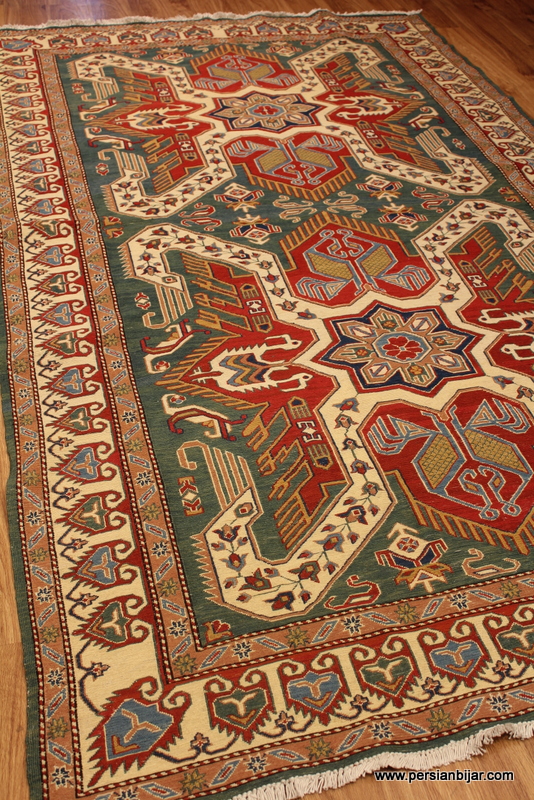
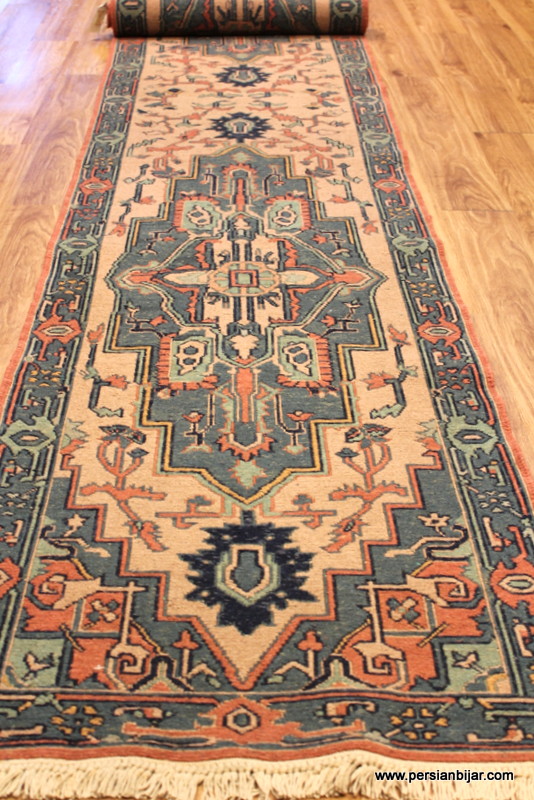
Designs
Because the wrapping stitch is so fine, a Soumak can show much more detail than a Kilim. Thin outlines, tiny motifs and small animals are all possible.
Soumak or Kilim?
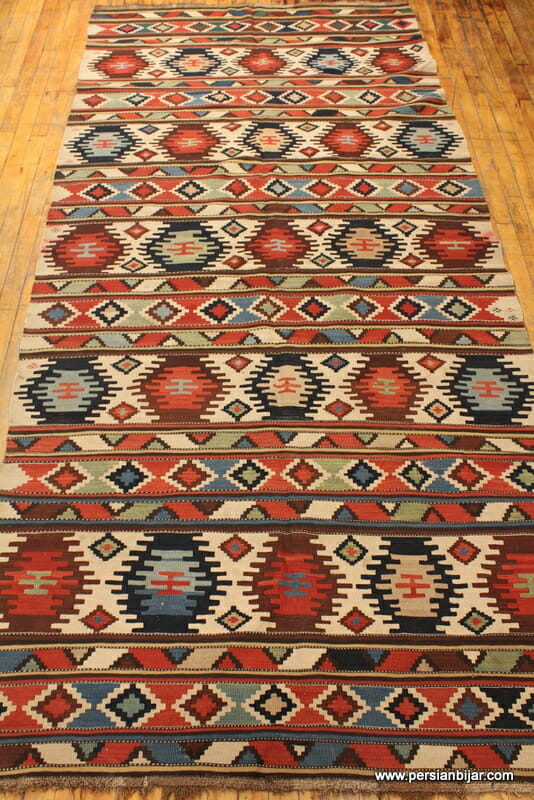
| Soumak | Kilim | |
|---|---|---|
| Technique | Yarn wrapped around the foundation | Yarn woven over and under the foundation |
| Surface | Ribbed, slanted stitches, like embroidery | Smooth and flat |
| Back | Shaggy with loose yarn ends | Same as the front |
| Reversible | No | Yes |
| Thickness | Thicker and heavier | Thin and light |
| Detail | Fine outlines and small motifs | Bolder blocks of color |
| Strength | Very strong for a flat weave | Good in lighter use |
We cover the other flat weave in our guide to Kilim rugs.
How to recognize a Soumak
- Run your hand across it.You should feel fine ridges, not the smoothness of a Kilim or the softness of a pile.
- Look closely at the surface.The stitches slant, and neighboring rows often slant in opposite directions.
- Turn it over.Loose ends of yarn on the back are the clearest sign.
- Feel the weight.A Soumak is heavier and stiffer than a Kilim of the same size.
Living with a Soumak
A Soumak is the most hard-wearing of the flat weaves, so it can go where a Kilim might struggle: a family room, a study, a hallway. It lies flat, it is easy to move furniture across, and it brings a great deal of pattern to a room without the height of a pile rug, which helps where a door has to clear it.
- Use a pad to stop it slipping and to cushion the weave.
- Vacuum with suction only, front side up.
- Do not trim the yarn on the back. Those ends are part of the structure.
- Rotate it once a year.
- Have it washed by a specialist who knows flat weaves.
Common questions
What is a Soumak rug?
A flat-woven rug made by wrapping colored yarn around the foundation threads, which gives a ribbed, embroidered-looking surface.
Is a Soumak the same as a Kilim?
No. Both are flat weaves, but a Kilim is woven and reversible, while a Soumak is wrapped, thicker, and has loose yarn on the back.
Are Soumak rugs durable?
Yes. They are the strongest of the flat-woven rugs, which is why nomads used the technique for bags and saddle covers.
Why is the back of my Soumak shaggy?
Those are the yarn ends left when the weaver changed color. They are normal and should not be cut.
See our Soumak and flat-woven rugs
Borokhim’s Oriental Rugs has served Madison since 1972. Browse our Soumak, Kilim and other flat-woven rugs online.
