 Borokhim's Oriental Rugs on
Persian Kashan Rugs: The Shah Abbas Design and How to Recognize One
Style: Kashan
By Borokhim’s Oriental Rugs · Madison, Wisconsin
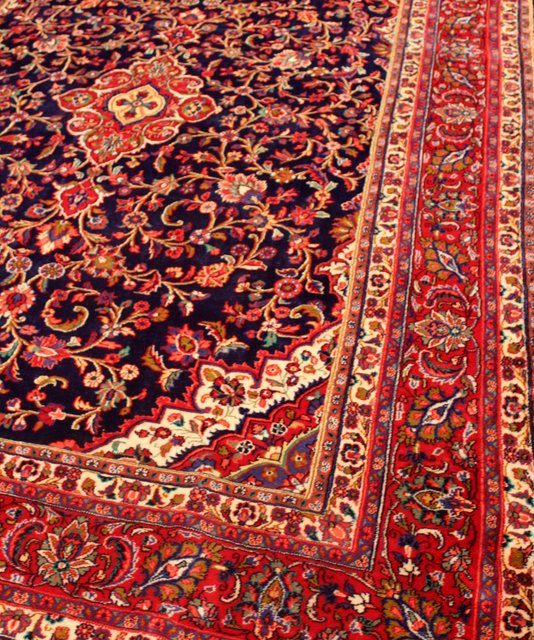
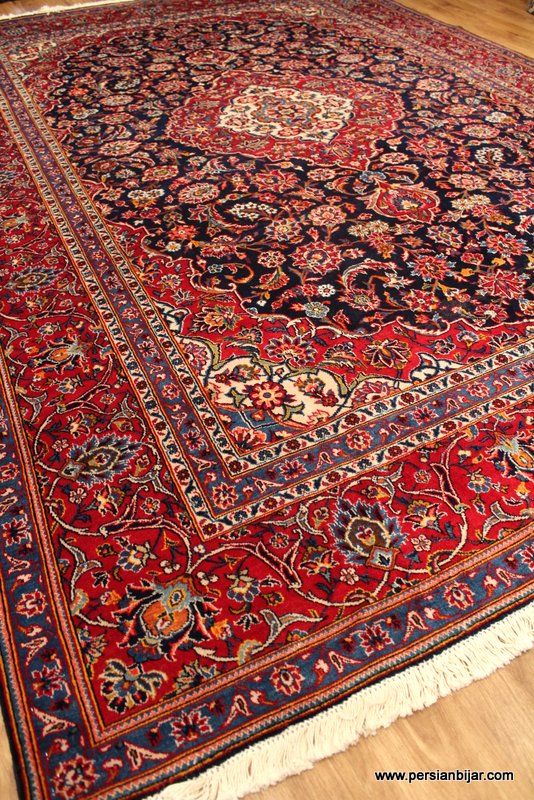
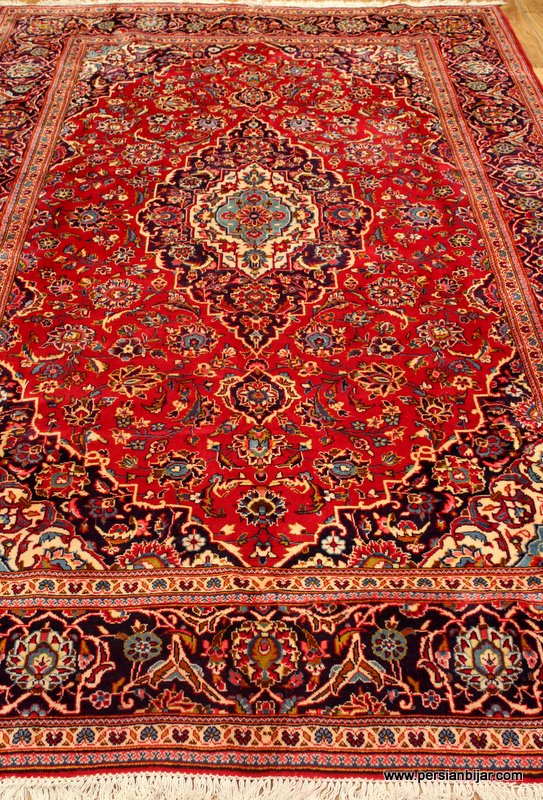
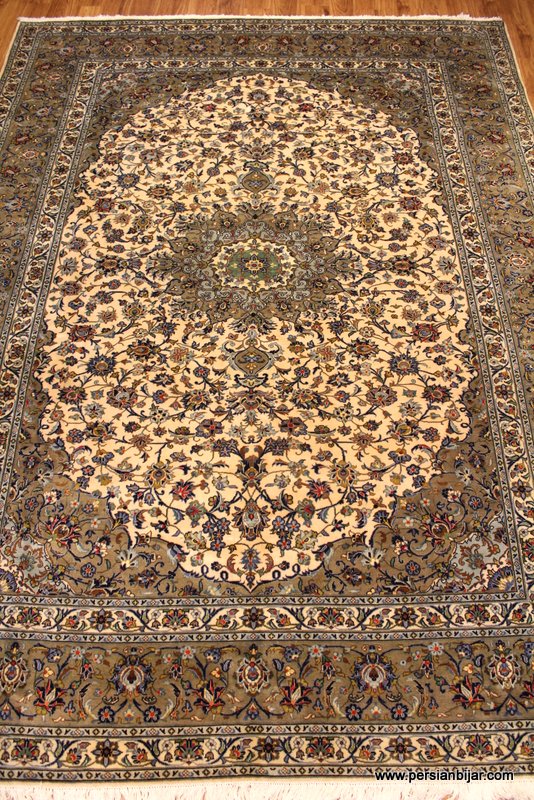
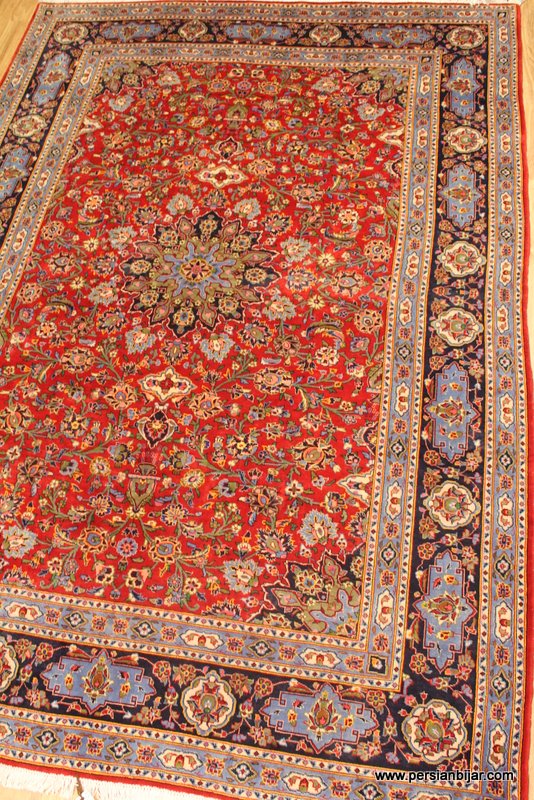
If one rug stands for the classic Persian carpet, it is the Kashan: a deep red field, a midnight-blue medallion at the center, and flowers, vines and palmettes filling every corner. The design is so well loved that it has been copied all over the world, but the originals still come from one city on the edge of the Iranian desert.
This guide looks at where Kashan rugs come from, the story behind the Shah Abbas design, and how to recognize a genuine Kashan.
| Woven in | The city of Kashan, central Iran, between Tehran and Isfahan |
| Look | Central medallion on a field of flowers and vines, in the Shah Abbas style |
| Colors | Deep red, midnight blue and warm ivory |
| Materials | Fine, soft wool on a cotton foundation |
| Knot | Asymmetric (Persian) |
| Sizes | Small rugs and runners up to very large carpets |
| Best for | Living rooms, dining rooms, bedrooms, entry halls |
A weaving city with a long memory
Kashan is an oasis city on the old road between Tehran and Isfahan. It was famous for silk and fine textiles as far back as the 1500s. The most celebrated Persian carpet in any museum, the Ardabil Carpet in London, carries the signature of a master named Maqsud of Kashan and a date equal to 1539.
The carpets we call Kashan today date from a revival that began in the late 1800s. The finest rugs of that first period are known as Mohtasham Kashans, after a master weaver of the time, and they are eagerly collected.
The Shah Abbas design
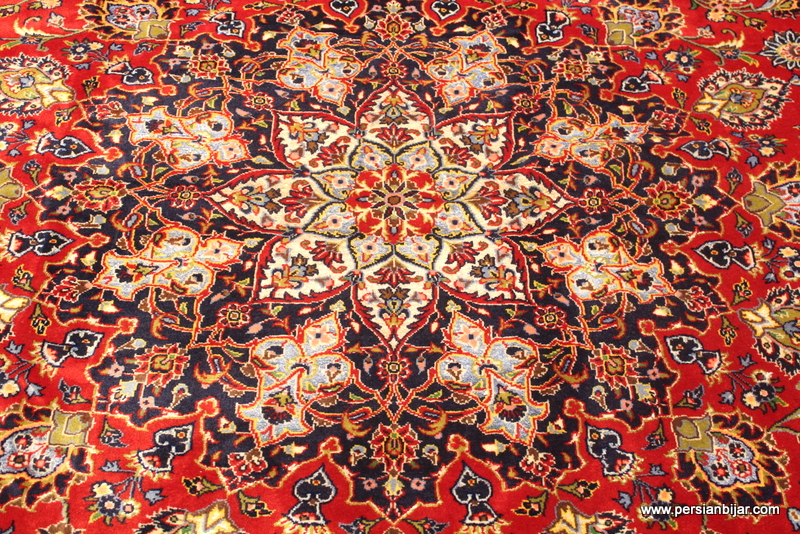
There is a famous mosque in the city of Isfahan. Stand under its dome and look up, and you see a great medallion at the center of the ceiling, with roses, palmettes and curling vines spreading outward from it, all worked in mosaic tile. That ceiling is the picture a Kashan weaver has in mind.
The design is named for Shah Abbas, the ruler who made Isfahan his capital around 1600 and filled it with mosques, palaces and royal workshops. In a rug it has three parts:
- The medallion at the center, often with a pendant above and below.
- The field, covered with blossoms and palmettes joined by slender vines.
- The corners, each holding a quarter of the medallion, so the rug reads like a framed ceiling.
Not every Kashan has a medallion. Some are woven in an all-over pattern, with the same flowers and vines running across the whole field and no center at all. These are useful where furniture would hide a medallion, such as under a dining table.
Color and wool
Most Kashans are woven in deep reds and midnight blues, with warm ivory for contrast. The red comes from madder root and the blue from indigo, and both deepen pleasantly with age. Ivory-field Kashans are less common and give a lighter, more open look.
The wool is fine and soft, which is why a Kashan feels so pleasant underfoot. It is knotted with the Persian knot onto a cotton foundation, and the weave is dense enough to stand up to normal family use for decades.
How to recognize a Kashan
- Look at the layout.A curving medallion, flower-filled field and quartered corners are the first sign.
- Check the palette.Red, navy and ivory, in rich but not harsh tones.
- Follow the vines.The drawing is curving and graceful, with no sharp angles.
- Feel the pile.The wool is soft and fine, cut to a medium height.
- Turn it over.The back shows a tight, even weave with the pattern clearly visible, on a cotton foundation.
Living with a Kashan
A Kashan brings warmth and a sense of occasion to a room. It suits a living room or dining room with traditional furniture, and the red and blue palette works well with dark wood. In a bedroom, a smaller Kashan beside or at the foot of the bed adds color without overwhelming the space.
Use a good pad, rotate the rug every year or two, and vacuum with suction only. Our rug size guide gives simple rules for each room.
Common questions
What is the Shah Abbas design?
A layout of medallion, palmettes and curling vines, named for the Persian ruler Shah Abbas and inspired by the tiled domes of Isfahan.
Are Kashan rugs good quality?
Yes. A genuine Kashan combines fine wool, a dense weave and a cotton foundation, and it will last for generations with ordinary care.
What is a Mohtasham Kashan?
An antique Kashan of the finest quality, woven in the late 1800s and early 1900s and named after a master weaver of that period.
Do all Kashan rugs have a medallion?
No. Some are woven with an all-over pattern and no central medallion.
See our Kashan rugs
Borokhim’s Oriental Rugs has served Madison since 1972. Browse our Kashan rugs online, in room sizes, small rugs and runners.
