 Borokhim's Oriental Rugs on
Persian Heriz Rugs: Why These Bold Village Rugs Last for Generations
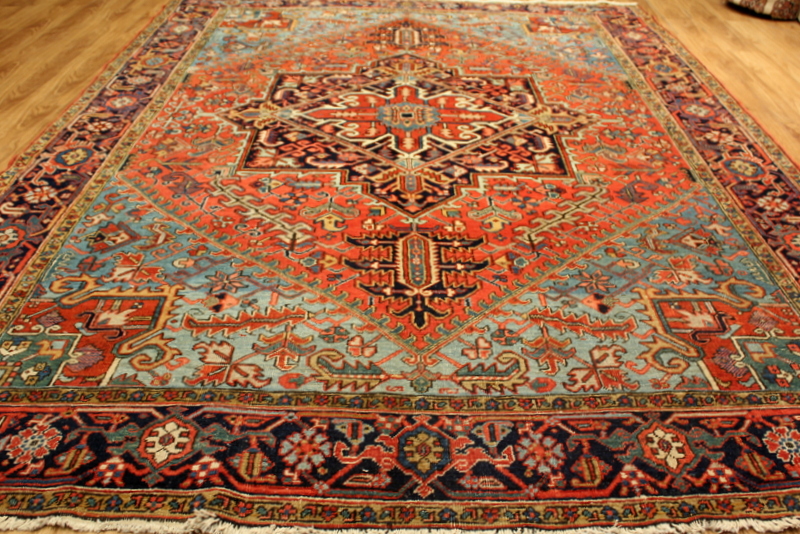
Style: Antique Heriz
By Borokhim’s Oriental Rugs · Madison, Wisconsin
A Persian Heriz is the rug people picture when they think of a bold Oriental carpet: a large angular medallion, strong outlines, and warm brick reds set against navy and ivory. It is also one of the toughest hand-knotted rugs ever made, which is why so many Heriz rugs woven a century ago are still on the floor today.
Heriz rugs are woven in the town of Heris and the villages around it, on the slopes of Mount Sabalan in north-western Iran. This guide covers what makes them different, the names you will hear in a rug shop, and how to choose one.
| Woven in | Heris and nearby villages such as Ahar, Gorevan, Mehraban and Bakhshayesh, East Azerbaijan province, Iran |
| Look | Large geometric medallion with stepped corner pieces |
| Materials | Thick wool pile on a cotton foundation |
| Knot | Symmetric (Turkish) |
| Colors | Brick and rust red, navy, ivory, with light blue, salmon and green |
| Sizes | Mostly room-size, 8 by 10 feet and larger |
| Best for | Living rooms, great rooms, dining rooms, dens |
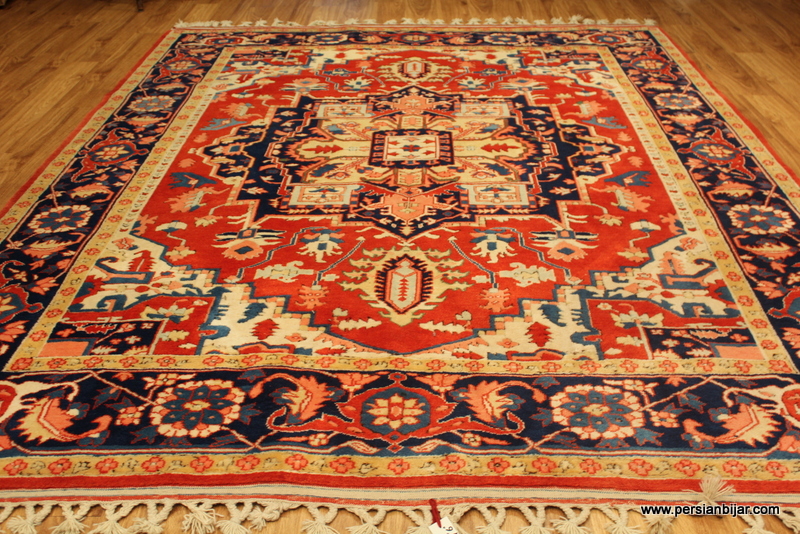
Why Heriz wool wears so well
Ask a rug dealer why a Heriz lasts so long and you will usually get the same answer: the water. The streams around Heris run over ground that is rich in copper and other minerals. The sheep drink from them and graze beside them, and the wool that results is unusually strong and resilient. That is the explanation Albert has given customers for more than fifty years.
Whatever the chemistry, the result is not in doubt. Heriz wool is thick, springy and slow to wear. Combine that with a heavy cotton foundation and a sturdy weave, and you have a rug that shrugs off decades of family life.
A design drawn in straight lines
Most Persian city rugs are full of curves. A Heriz is drawn in straight lines and angles. The usual explanation is that village weavers were working from the curving medallion designs of nearby Tabriz, and translated them into the bolder geometry that their thicker yarn allowed.
Heriz weavers also work largely from memory, without a detailed paper pattern. So no two rugs come out the same. The medallion may be a little larger in one, the corners a different shape in another. That individuality is a large part of their charm.
Abrash: the bands of color
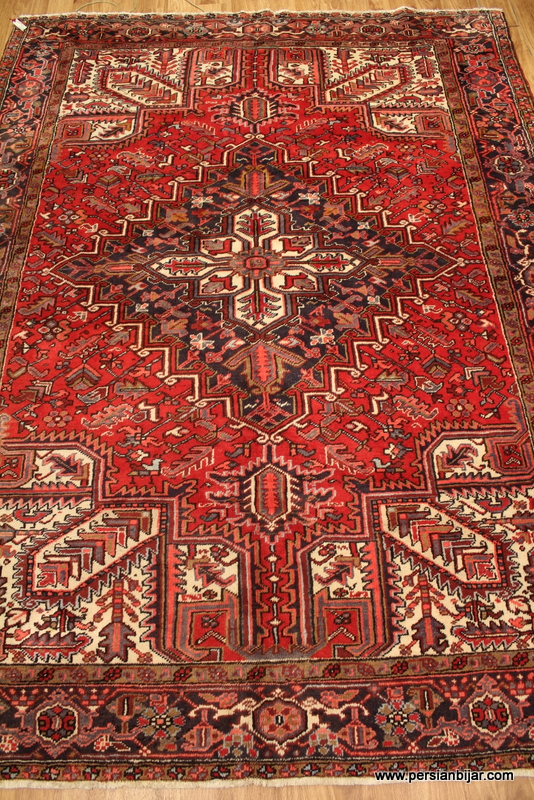
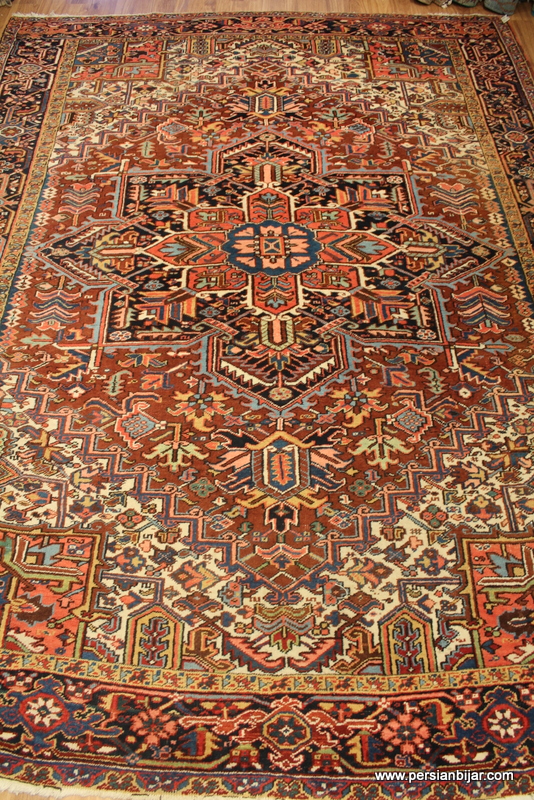
Look closely at the field of a Heriz and you will often see soft horizontal bands where a red or a blue shifts a shade lighter or darker. This is called abrash.
It happens because different batches of wool take the same dye differently. Wool from one shearing, or one part of the fleece, absorbs a little more color than the next. When the weaver finishes one batch of yarn and starts another, the change shows as a band. Abrash is not a flaw. It is one of the surest signs that a rug was dyed and knotted by hand, and many buyers look for it.
Names you will hear
How to recognize a Heriz
- Start with the medallion.It is large, angular and clearly outlined, with matching stepped pieces in the four corners.
- Look at the colors.Expect brick or rust red with navy and ivory, not bright scarlet.
- Feel the pile.It is thick and firm. The rug is heavy for its size.
- Turn it over.The knots are fairly large and even, and the pattern is as clear on the back as on the front.
- Check for abrash.Gentle bands of shade in the field point to hand-dyed wool.
Where a Heriz works best
A Heriz needs room for its medallion to be seen, so it suits larger spaces: a living room, a great room, or a dining room with the table centered on the medallion. It is one of the easiest Persian rugs to live with. The warm reds work with leather, wood and stone, and the geometric drawing looks as natural with modern furniture as with antiques.
If you are deciding between types, our comparison of Bijar, Heriz and Tabriz rugs sets them side by side, and the rug size guide will help you measure the room.
Common questions
Are Heriz rugs durable?
Very. They are among the most durable of all Persian rugs, and a good one will serve several generations.
What is the difference between a Heriz and a Serapi?
They come from the same district. Serapi is the name dealers give to the older and finer pieces, usually woven before about 1900.
Do Heriz rugs come in small sizes?
Some do, but most are room-size. Small Heriz rugs and runners turn up less often.
Is the uneven color in my Heriz a defect?
No. Those bands are abrash, the natural result of hand-dyed wool, and they are considered part of the rug’s character.
See our Heriz rugs
Borokhim’s Oriental Rugs has served Madison since 1972 and ships to customers across the United States. Browse the Heriz collection online, or ask us about a rug for a particular room.
